![[personal profile]](https://www.dreamwidth.org/img/silk/identity/user.png)

Sep. 25th, 2017 at 7:17 AM
![[livejournal.com profile]](https://www.dreamwidth.org/img/external/lj-userinfo.gif) prettygoodword at aconite
prettygoodword at aconiteaconite (AK-uh-nait) - n., any of about 250 plants, many of them poisonous, belonging to the genus Aconitum (in the buttercup family) having irregular flowers usually in loose clusters; any of around eight closely related plants of the genus Eranthis, more usually called winter aconite.
Also called monkshood, wolfsbane, leopardsbane, mousebane, women's bane, devil's helmet, queen of poisons, and blue rocket. Monkshood is especially applied to A. napellus, which was cultivated for medicinal purposes (and used very carefully because poisonous. Winter aconite is among the first flowers of spring where they grow. The word is from French aconit, from Latin aconītum, from Greek akonīton, the name of the plant, of uncertain origin.
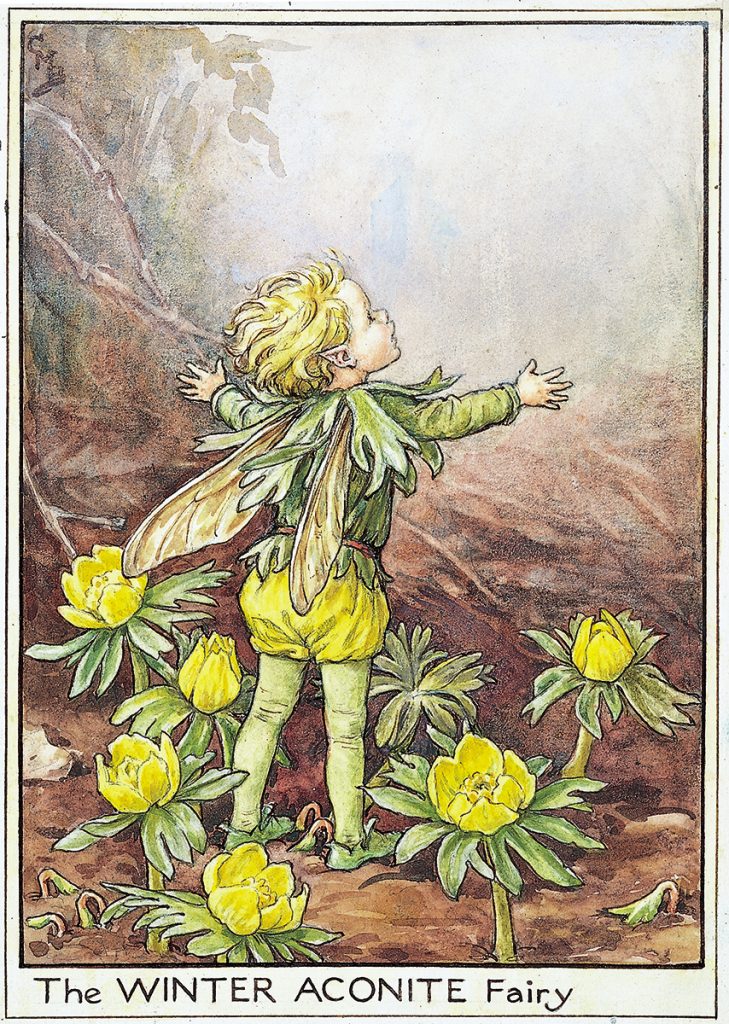
Deep in the earth
I woke, I stirred.
I said: “Was that the Spring I heard?
For something called!”
“No, no,” they said;
“Go back to sleep. Go back to bed.
Up, up, I climbed,
“You’re far too soon;
The world’s too cold
For you, so small.” So I was told.
But how could I
Go back to sleep?
I could not wait; I had to peep!
And here am I.
How wide the earth! How great the sky!
O wintry world,
See me, awake!
Spring calls, and comes; ’tis no mistake.
---L.
Also called monkshood, wolfsbane, leopardsbane, mousebane, women's bane, devil's helmet, queen of poisons, and blue rocket. Monkshood is especially applied to A. napellus, which was cultivated for medicinal purposes (and used very carefully because poisonous. Winter aconite is among the first flowers of spring where they grow. The word is from French aconit, from Latin aconītum, from Greek akonīton, the name of the plant, of uncertain origin.
Deep in the earth
I woke, I stirred.
I said: “Was that the Spring I heard?
For something called!”
“No, no,” they said;
“Go back to sleep. Go back to bed.
Up, up, I climbed,
“You’re far too soon;
The world’s too cold
For you, so small.” So I was told.
But how could I
Go back to sleep?
I could not wait; I had to peep!
And here am I.
How wide the earth! How great the sky!
O wintry world,
See me, awake!
Spring calls, and comes; ’tis no mistake.
—Cicely Mary Barker
---L.
Crossposts: http://prettygoodword.dreamwidth.org/672029.html
You can comment here or there.
You can comment here or there.
Comments
Conan Doyle had used it in one of his poems, in the third verse here:
Man's Limitation
Man says that He is jealous,
Man says that He is wise,
Man says that He is watching
From His throne beyond the skies.
But perchance the arch above us
Is one great mirror's span,
And the Figure seen so dimly
Is a vast reflected man.
If it is love that gave us
A thousand blossoms bright,
Why should that love not save us
From poisoned aconite?
If this man blesses sunshine
Which sets his fields aglow,
Shall that man curse the tempest
That lays his harvest low?
If you may sing His praises
For health He gave to you,
What of this spine-curved cripple,
Shall he sing praises too?
If you may justly thank Him
For strength in mind and limb,
Then what of yonder weakling —
Must he give thanks to Him?
Ah dark, too dark, the riddle!
The tiny brain too small!
We call, and fondly listen,
For answer to that call.
There comes no word to tell us
Why this and that should be,
Why you should live with sorrow,
And joy should live with me.
(Conan Doyle, 1911)
It has no place in modern herbal medicine. There's nothing aconite can do that any number of safer plants can't do better. I tell my students to leave all the poisonous herbs strictly alone: this is not the Middle Ages, and there is no justification for trying dangerous folk remedies. Doctors have malpractice insurance in case they accidentally poison someone; we don't.
...There's another consideration, isn't there, _before_ malpractice insurance, in either case, isn't there?...
(I didn't know you teach herbal medicine, that's neat :))
I don't specifically teach herbal medicine. Herbal medicine and other healing techniques are part of the traditions of my faith, in which I'm a clergywoman. The law allows a loophole in the 'practicing medicine without a license' thing, for religious traditions, but it's a very small loophole, and not to be relied upon. I don't prescribe; I don't even recommend (except when I'm recommending a Real Doctor!) - I only provide information.
One very important piece of information is that poison really will hurt and/or kill you. It might seem like everybody already knows that, but you would be astounded and horrified at the many instances of Stupidity With Toxic Substances I've witnessed - none lethal, fortunately, but they very well could have been. So I am pretty heavy-handed in talking about potential consequences.
It's probably a sad commentary on human nature, that "you could accidentally kill someone" makes less impression than "you could go to prison".